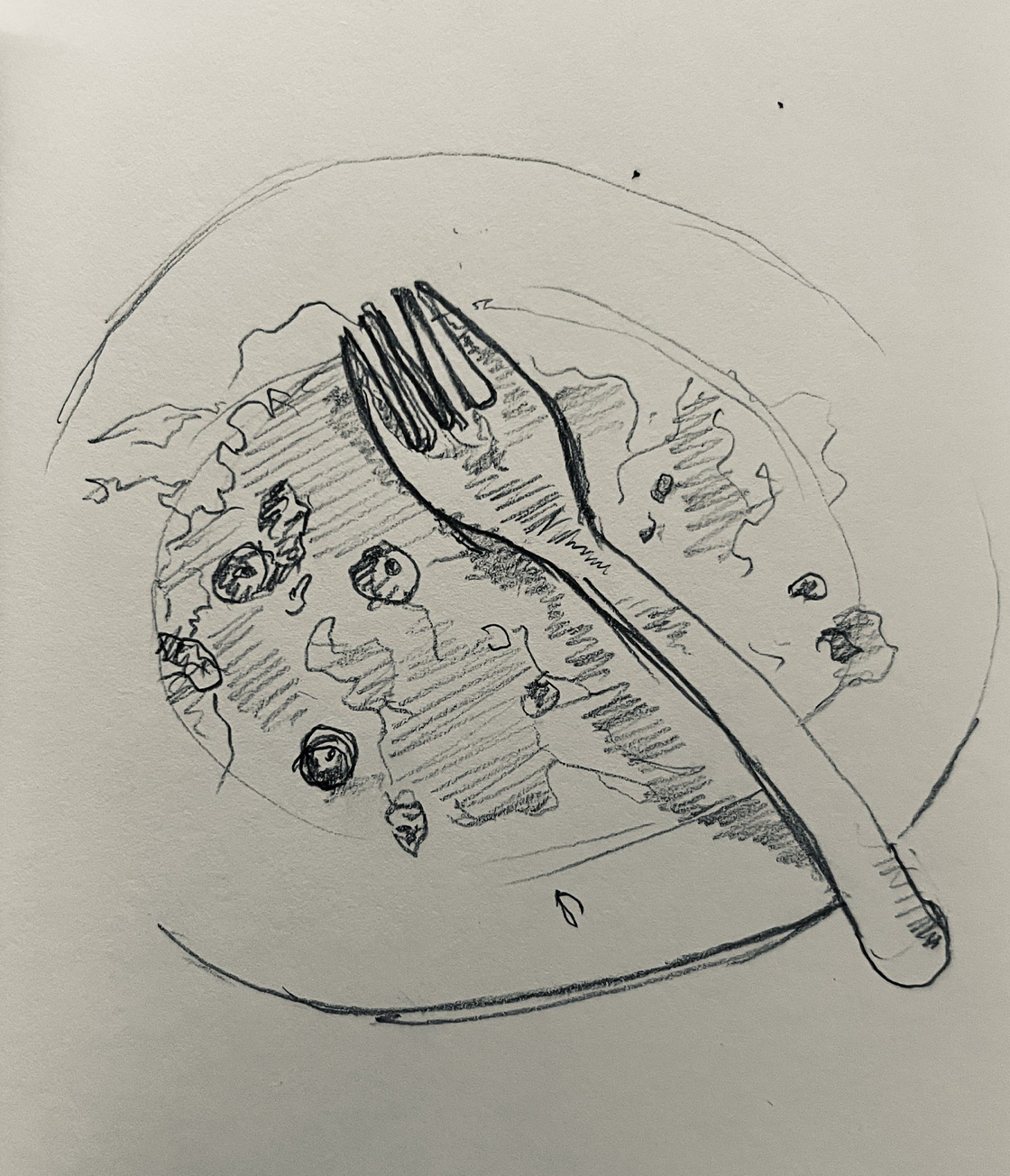
Dish washing the ultimate creative act!
Before we get going, I want to make one thing clear: I hate doing washing up. Despite my aversion to doing the dishes, it has taught me some valuable lessons. Here are five that I apply almost daily to my creative practice as a designer.
1. Wait, let it soak
We often make oatmeal in the morning. We often don't wash the pot we made it in immediately, so when I find a pot which has bits attached to it which feel like concrete, instead of struggling to detach them, I just fill the pot with hot water and detergent and let it sit for 5 mins. After that, removing the bits is easy.
This is exactly what you need to do when you come across a design problem which is unclear. Let it soak. This might mean stopping thinking about it or it might mean reading an article about the problem space and just letting your mind turn over for an hour or a day. When you come back to the problem, something will often occur to you that did not seem obvious at the time. Soaking in a problem is important. Hard work is great, but hard work can often get in the way when the problem is unclear.
2. Focus, give it just 5 minutes
Whenever I see a big pile of dishes in the sink, instead of looking on in despair, I think to myself, “ I will do as much as I can in the next 5 minutes.” Turns out you can do a lot of dishes in 5 minutes. To solve most problems, you don't need to have a solution in mind; you just need to get started. Most complex problems are like the dishes; they will never be done. Constant effort is required. So just get started, give the problem 5 minutes, and then maybe another 10. Write something down, make a sketch or a diagram. Do anything, and you will be shocked at how much progress you can make. (Rome was not built in a day, but it was built by getting started and not overthinking it.) Once you have made a bit of progress, that 5, 10, or 15 minutes might turn into an hour because progress compounds.
3. Meditate, while you wash
Doing washing up is many things, but it is not difficult. Tedious, messy, annoying, but not difficult. When I am doing the dishes, I find myself letting my thoughts wander. Turns out that doing the washing up is a great time to think through bigger problems while your hands are occupied with something.
Design problems often require this type of background thinking. I think we can all agree that it's pretty hard to meditate on an idea in front of a computer, a device with lots of distractions. Start with a piece of paper. Drawing a couple of boxes or a diagram does not look like much, but it will give your mind a break from having to do the difficult work of manipulating some kind of computer application and allow your mind to do something simpler. This time and space might be just what your unconscious needs to unlock a problem while you keep your conscious mind occupied with the dishes.
4. Persist, it never goes away
Washing up is a constant; even if you have a dishwasher, you still have to load it and unload it. Taking the time and doing this consistently helps you keep a stack of clean plates to eat from. This is true in your creative practice. Improvement requires lots of repetition and consistent practice. You are never going to create the perfect design in the same way as you are never going to finish the dishes.
5. Systems help you think
You can just attack the washing up by picking up the first thing you see and cleaning it, or by putting the first thing you see into your dishwasher (I know many of you would be against this; I have heard there is an art to loading a dishwasher!), but this haphazard approach can lead to uneven results and frustration. Another way of doing the dishes is to develop a system. Tackle the big pots first, or get all the glasses done. Whatever it is, a system helps organize your thinking and approach and leads to getting the dishes done more quickly and with less frustration.
Design problems are much the same. Start designing something without all the facts or a clear goal, and you end up often making something that just does not work. Those first moments of setting up a system to approach a problem are important. Why are we making this (the goal), what does it do (the objective), and how will someone benefit (the outcomes) are a simple system of questions you can set up before trying to solve any problem. This requires you to spend a little time thinking and writing up front but saves you a ton of time later; you won’t need to backtrack to understand the problem you were trying to solve in the first place.
Creativity is not a magic trick or a natural talent; it's a mixture of waiting, focus, meditation, persistence, and building your systems. It's a constant challenge, and that’s the path to growth.
If you liked this article, please share it with just one other person. Word of mouth is a great way to help Design + Culture grow. Thanks